Exploring Augmented Reality with ARCore
summary
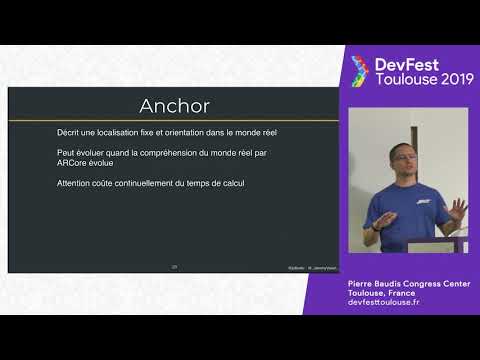
This talk explains Google ARCore’s capabilities and limits: plane and light estimation, 6DoF visual‑inertial SLAM tracking, face mesh (~468 points), image database up to 20 entries, and Cloud Anchors that persist about 24 hours. It compares native Android and Unity workflows, describes Web integration via modelviewer with practical limits (~30k vertices, 10 materials, one animation), and demonstrates a 3D mapping example combining Bing coordinates, OpenElevation heights and OpenStreetMap tiles that highlights jitter, occlusion gaps on Android and a practical anchor limit of about 20.
AI-written summary · about
chapters (14)
- 0:00Start
- 4:33Vertex, edge, mesh
- 5:07Texture, Shader, Material
- 7:32ARCore perception
- 8:02Light
- 8:55Motion tracking
- 9:23Sound localization
- 9:57Usage
- 16:27Renderable
- 20:53AugmentedFace
- 21:26Augmented images
- 27:29ARCore vs Vuforia
- 28:06Why Unity?
- 36:06Who supports OpenXR?
related talks
 44mDiscovering Augmented Reality with ARCore
 40mDiscovering Augmented Reality with ARCore
 35mExploring augmented reality with AR Core
 38mIntro to ARCore
 01h 16mAugmented Reality For The Masses
 15mARCore: Augmented Reality at Android scale
 44mAdd some reality to your app with ArCore
 41mAUGMENTED REALITY FOR EVERYONE, EVERYWHERE WITH ARCORE