Machine API in OpenShift - Deep DIve

summary
Machine API exposes providerSpec templates to create/delete VMs across Azure/GCP/AWS/vSphere and maps each VM to a Kubernetes Machine object with five lifecycle phases: provisioning, provisioned, running, deleting, failed. A node link controller matches node.providerID to a Machine; nodes drain before the controller deletes the cloud VM. MachineSet acts like a ReplicaSet and recreates deleted machines. MachineHealthCheck automatically deletes unhealthy machines when they exceed maxUnhealthy. ClusterAutoscaler defines cluster-wide scaling rules; MachineAutoscaler sets min/max replicas per MachineSet.
AI-written summary · about
chapters (10)
- 0:00Start
- 3:20The Machine Object
- 5:02Managing Machines
- 5:27Machine Creation
- 6:14Checking if Cloud Instance Exists
- 11:40Machine Health Checks
- 13:26Auto Scaling
- 15:53Machine Deletion
- 16:45Is There a Way To Adopt Existing Nodes as Machines
- 17:12Is Machine Api Doing Requests To Cluster Machine Approver or How Does It Validate that the Csr Endpoint Is Actually Approved or Not
related talks
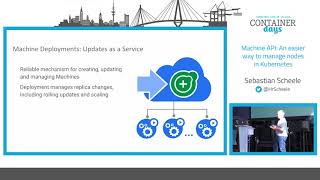 16mMachine API: An easier way to manage nodes in Kubernetes
 21mCluster API Deep Dive
 39mCluster API & Cluster Autoscaler
 26mAnatomy of a Kubernetes Cloud Provider
 33mCluster API Deep Dive
 42mDeep Dive: Cluster Lifecycle SIG (Cluster API)
 38mCluster API Deep Dive With a Tencent Case Study
 25mIntroduction To Cluster API