From Jenkins-under-your-desk to resilient service

summary
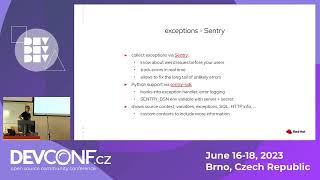
CKI evolves from a Jenkins proof-of-concept into a production CI service that gates Fedora/CentOS/RHEL kernel merge requests and is used daily by kernel developers. It runs on containers and GitLab runners, stores artifacts on AWS S3 and MinIO, wires components with a rabbitmq cluster to enable automatic retries, and adds observability with Loki + Prometheus and Grafana alerts plus Sentry for traces. Resilience features include a pipeline herder bot that auto-retries known failures, per-merge-request canary pipelines, and automated safe deployments.
AI-written summary · about
chapters (25)
- 0:00Intro
- 0:40Proof of concept
- 1:05Revisiting problems
- 2:35Target testing
- 2:52Fasting keywords
- 3:08Main dilemma
- 3:54Our infrastructure
- 4:59Components
- 6:02Optional components
- 8:27S3 buckets
- 10:15Detection
- 11:29Visualization
- 13:27Network
- 14:36Pipeline Helper
- 15:07Failed fallbacks
- 15:29Devops culture
- 17:13Openness
- 18:31Documentation
- 20:12Open channel
- 21:11Architectural decision records
- 21:30Safety
- 23:04Microservices
- 29:33Running pipeline
- 30:11Testing changes
- 30:38Production deployments
related talks
 37mIncident management for small service teams
 27mPlugging into the Red Hat kernel CI ecosystem
 39mJenkins X Progressive Delivery For Kubernetes
 40mOne year into the new KernelCI
 13mEvolution of containers in continuous integration
 39mAccelerate your CI/CD on Kubernetes with Jenkins X
 42mJenkins X, Continuous Delivery for Kubernetes
 36mThe Kubernetes hitchhiker's guide to CI/CD