Gradient Boosting Machines (GBM): from Zero to Hero (with R and Python code)

summary
Claims GBMs usually beat deep learning on structured/tabular business data and are easy to run: demos use xgboost lightgbm and h2o from R and Python on an airline dataset (~100k rows), with training under a few seconds on a laptop and test AUC ≈ 0.73. Practical details: one-hot encode categoricals into sparse matrices, use XGBoost DMatrix or LightGBM datasets, enable early stopping and GPU via gpu_hist, and deploy H2O models as a REST service.
AI-written summary · about
chapters (12)
- 0:00Introduction and welcome
- 1:47Deep learning vs GBM for business
- 8:29Prerequisites for machine learning
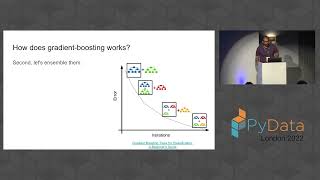
- 9:33What is gradient boosting
- 11:42GBM libraries comparison
- 15:58Demo setup and R code
- 21:44Demo summary and Python code
- 27:47GPU and H2O usage
- 29:19When to use GBMs
- 31:05Q&A on overfitting and validation
- 35:10Q&A on high AUC and time splits
- 39:44Closing remarks
related talks
 41mBetter Than Deep Learning: Gradient Boosting Machines (GBM)
 37mUnlocking the Power of Gradient-Boosted Trees (using LightGBM)
 38mCatBoost - the new generation of gradient boosting
 18mCompetitive Analysis of the Top Gradient...
 42mDeep Learning is Like Water (it's Everywhere!)
 37mGradient Boosting for Data with Both Numerical and Text Features
 01h 39mApplying Rigorous Machine Learning Methods in Business Strategy
 01h 28mMastering gradient boosting with CatBoost