Integrating Microsoft Fabric and Databricks for Modern Data Analytics
summary
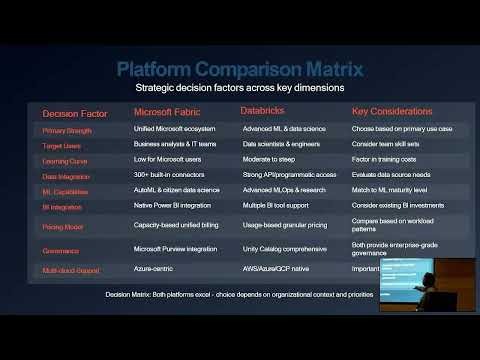
Compares Microsoft Fabric and Databricks head-to-head with concrete guidance: use Databricks for heavy ML/AI and Fabric for PowerBI-led BI, integrate via shortcuts and mirroring or Databricks live data share, store in OneLake/Parquet/Delta Lake to get time travel and ACID semantics, watch performance across data optimization compute and network, expect integration ROI in about 1.5–2.5 years with reported average returns near 250% ROI and a retail M&A case showing roughly $250 million impact.
AI-written summary · about
chapters (15)
- 0:00Introduction
- 1:10Why integrate Fabric and Databricks
- 3:59Industry challenges and drivers
- 6:10Microsoft Fabric architecture
- 8:17Databricks Lakehouse concept
- 10:22Fabric versus Databricks differences
- 12:52Advantages and use cases
- 13:57Integration challenges
- 15:02ROI and examples
- 17:50Three integration layers
- 18:53Performance and security
- 19:37Best practices
- 21:48Technical deep dive
- 22:28Streaming and Lakehouse evolution
- 24:57Summary
related talks
 21mThe Future of Data Analytics: Adapting to the Shifting Technology Landscape
 27mModernize your data integration to enable petabyte scale analytics with Microsoft Fabric
 30mDataEngBytes 2023 - BRI-T1-04 - Mimoune Djouallah
 42mAn Evolution of Data Architectures - Lambda, Kappa, Delta, Mesh & Fabric
 46mMicrosoft Fabric Synapse data warehouse Q&A
 51mA Deep Dive into Microsoft Fabric Data Warehouse
 50mMicrosoft Fabric Data Factory Q&A
 48mWhat does Microsoft Fabric mean for a Finance/Business Analyst?