Intro to Privacy-Enhancing Technologies (PETs)
summary
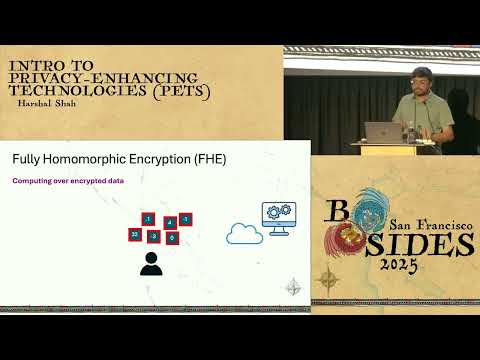
Covers practical PETs: Secure Multiparty Computation and Fully Homomorphic Encryption with concrete workflows — an 18‑voter election produces an encrypted sum of 10 (majority >9) without a trusted officer; an advertiser‑retailer lookup returns encrypted 16 so retailer never sees the query; Apple and Google/Microsoft examples of HE for private ID/password checks; MPC secures synthetic data and model inference; a custody wallet splits a key into 2‑of‑3 secret sharing so two parties recover signatures; notes that addition is cheap, multiplication costly.
AI-written summary · about
chapters (13)
- 0:00Introduction and welcome
- 0:43What are PETs
- 2:31History and adoption of PETs
- 4:37Election example with encryption
- 8:27Fully homomorphic encryption explained
- 12:01FHE real-world use case
- 14:33Secure multi-party computing basics
- 19:14Synthetic data with MPC
- 21:42MPC in custody wallets
- 25:38FHE vs MPC comparison
- 26:43Industry adoption of PETs
- 27:05Utility vs compute tradeoffs
- 28:08Federated learning and privacy
related talks
 16mBalancing Privacy: Leveraging Privacy Budgets for Privacy-Enhancing Technologies
 12mDon't End Up in the PETs Cemetery
 01h 17mBridging the Gap with PETs Governments' Opportunity to Lead on Innovation and Privacy
 20mDeep Dive into Privacy Enhancing Technologies
 24mPETAce - Using Applied Cryptography to Enhance Privacy
 01h 19mWhen Data Can’t Move but Insight Must
 01h 16mCommercial opportunities for designing privacy in: Embedding privacy ...
 13mSurvey of Privacy Solutions for Minimizing MEV