Rethinking Computing with Neuro-Inspired Learning: Algorithms to Hardware

Talkat Algorithmic Foundations for Emerging Computing Technologies Boot Camp 2025 · 2025-09-08..09-12·
summary
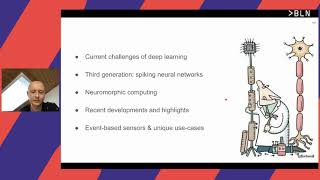
Argues that brains beat AI on energy: fruit fly uses microwatts while a prototype “flying monkey” needs 1–2 W, and global chatbot ops cost about 3.65–36.5 TWh (≈ five Hoover Dams) annually. Proposes sensor-plus-network co‑design using a DVS event camera feeding hybrid spiking/analog nets (optical‑flow nets from 13M to 60k params; a hybrid 7.5M‑param model), and hardware co‑design: analog/digital CiM, ADC‑less CiM with binary partial sums and learned scale factors, ROM overlays for softmax, and device tradeoffs (RRAM drift, MTJ TMR ~150–200).
AI-written summary · about
chapters (15)
- 0:00The efficiency gap
- 2:16Rethinking AI design
- 5:14Neuro-inspired computing
- 8:06Sensor fusion and navigation
- 12:20Algorithms for vision
- 19:46The memory wall bottleneck
- 25:00Compute-in-memory challenges
- 30:47Mitigation and device design
- 35:09Hardware architectures
- 39:35SRAM-based CIM macro
- 43:09Reducing ADC overheads
- 50:03Hybrid analog-digital CIM
- 52:00Co-designing NVM and RRAM
- 55:13On-chip functional support
- 1:07:11Future directions and Q&A
related talks
 01h 14mTissue vs silicone musings on the future of deep learning hardware and software
 43mKeeping Moore's law alive: Neuromorphic computing
 41mBrain-inspired computational primitives for reliable neuromorphic intelligence
 21mOrganoid Computing – Can Nature Save AI?
 29mDeep Learning, Neuroscience and the future of AI
 11mNext Generation AI Computing
 20mRecap and Closing Remarks: Neuropunk revolution and energy consumption
 32mHow Neuroscience Makes AI Intelligent