DATA – Differential Address Trace Analysis: Finding Address-based Side-Channels in Binaries

summary
DATA is a dynamic binary tool that records full address traces via binary instrumentation, realigns traces with a novel re-alignment algorithm, and applies a two-stage statistical testing pipeline to filter nondeterminism and quantify leakage. It reports concrete address-dependent leaks (data and control-flow) and highlights which leakage models expose key bytes. Applied to OpenSSL and PyCrypto it finds known and previously unknown RSA/DSA/ECDSA bugs, flags erroneous “fixed” constant-time patches, and scales: typical symmetric cases need 2–3 traces, asymmetric use ~10 traces, even RSA with >2,000 differences runs under a few CPU-hours.
AI-written summary · about
chapters (9)
- 0:00Intro
- 0:30What is Side Channel Leakage
- 1:22Address Leakage
- 4:29Static vs Dynamic
- 6:13Contributions
- 8:10Data in Practice
- 11:13Leakage Detection
- 16:11Practical Results
- 19:10Conclusion
related talks
 48mDPTrace: Dual Purpose Trace for Exploitability Analysis of Program Crashes
 17mQuantifying and Mitigating Cache Side Channel Leakage with Differential Set
 50mD2T2 - Exposing Hidden Exploitable Behaviors Using EDF
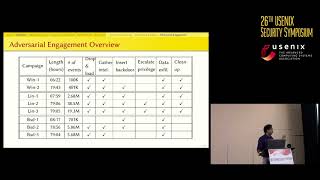 28mSLEUTH: Real-time Attack Scenario Reconstruction from COTS Audit Data
 29mAre Our Systems Using up-to-Date Cryptography?
 25mDRAMA: Exploiting DRAM Addressing for Cross-CPU Attacks
 36mCollide+Power: The Evolution of Software-based Power Side-Channels Attacks
 32mBlack box side-channel leakage verification using statistical approach