Lessons Learned from the Chameleon Testbed
summary
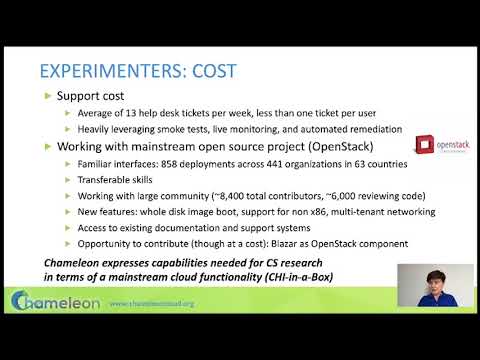
Chameleon adapts mainstream cloud tech into a research-focused platform: it is an openstack-based cloud with deep reconfigurability, advanced reservations via an allocatable resource abstraction, and orchestration using Heat plus Jupyter integration for multi-node experiments. The testbed hosts over 4,000 users, 275 reported publications, and a 75% renewal rate; storage is nearly 6 PB global store; largest lease reached 120 nodes. These extensions reduce operational cost, increase reproducibility (Zenodo integration for DOI publishing), and show the model scales in practice.
AI-written summary · about
chapters (13)
- 0:00Intro
- 0:40CHAMELEON IN A NUTSHELL We like to change: a testbed that adapts itself to your experimental needs
- 2:36THE MOST EXPERIMENTS FOR THE MOST USERS
- 4:51EXPERIMENTS: HARDWARE
- 6:13EXPERIMENTS: ALLOCATABLE RESOURCES
- 8:28EXPERIMENTS: EXPRESSIVENESS Resources can be specified at different levels
- 12:19EXPERIMENTERS: COST Support cost
- 15:09EXPERIMENTERS: ACTIVE USERS
- 16:13EXPERIMENTERS: ACTIVE LEASES
- 17:09EXPERIMENTERS: COMMUNITY
- 20:00SHARING EXPERIMENTS: PACKAGING
- 21:25SHARING EXPERIMENTS: PUBLICATION
- 23:09PARTING THOUGHTS
related talks
 19mThe Design and Operation of CloudLab
 16mA novel Cloud High Performance Computing infrastructure for user
 15mThe CERN Cloud Infrastructure: 5 years in 15 minutes
 21mBack to the original mission: an open cloud operating system
 15mAn open cloud for european researchers, staff and students
 13mAn open cloud for researchers, staff and students
 43mSupporting NASA Science with OpenStack
 39mThe campus as a living lab: Collaboration with data lakes