Orca: Differential Bug Localization in Large-Scale Services
Talkat USENIX ATC '19 · on Wednesday, 2019-07-10· at 16:50· USENIX ATC Track I: Grand Ballroom I–VI·
summary
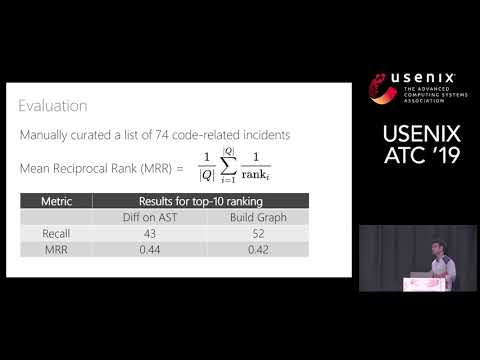
Orca takes symptom text and build number, opens the build graph to collect sibling/parent builds, and converts commits to AST diffs and touched paths. It scores matches using TF‑IDF tokens with higher weight for function/class name hits and returns a ranked list of suspect commits and PRs. Evaluated on 74 real incidents, it localizes the buggy commit for ~77% of cases, reports a mean reciprocal rank of ~0.44 (average position ~2–3), and cuts on‑call effort roughly 4x.
AI-written summary · about
chapters (7)
- 0:00Introduction to Arca
- 1:48Incident management process
- 3:46Key observations and challenges
- 7:26Technical approach
- 10:29System integration
- 11:16Evaluation and results
- 14:16Q&A session
related talks
 25mTroubleshooting at Scale: What DORA Metrics Miss
 19mAccelerating Code Quality with DORA Metrics
 49mTreat Your Code as a Crime Scene
 39mDev Team Metrics that Matter
 33mORT Automate compliance using Open Source & InnerSource
 28mGenerating a SPDX SBOM for Your Code in CI Using ORT
 50mGuide Refactorings With Behavioral Code Analysis
 10mMy Experience Creating an Orca Plugin for the First Time