Extraction and Interpretation of Deep Autoencoder-based Temporal Features from Wearables for ...
summary
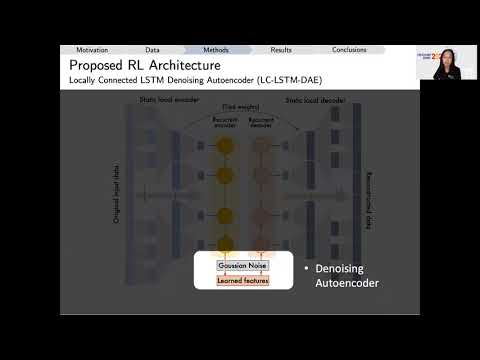
A Locally Connected LSTM Denoising AutoEncoder (LC-LSTM-DAE) learns temporal features from 8 Hz Affectiva Q-sensor streams (skin conductance, skin temperature, acceleration) and is fine-tuned per person to predict self-reported mood, health, and stress (0–100) using 6391 days from 239 participants. Temporal auto features beat hand-crafted and static auto features, 7-day windows outperform 1-day, and individual-as-task personalization improves health and stress MAE even though per-user reconstruction gains do not fully transfer to prediction.
AI-written summary · about
chapters (11)
- 0:00Introduction
- 0:48Data Complexity
- 1:12Decomposition
- 1:28Feature Learning
- 2:14Personalization
- 3:14Interpretation
- 3:41Results
- 4:05Results Comparison
- 4:45Correlation Matrix
- 5:09Limitations and Improvements
- 5:35Conclusion
related talks
 25mLooking beyond LSTMs: Alternatives to Time Series Modelling using Neural Nets
 06mThe Empathetic Car: Exploring Emotion Inference via Driver Behaviour and Traffic Context
 36mPhysics-Informed Spatiotemporal Deep Learning for Emulating Coupled Dynamical Systems
 31mAdvanced machine learning time series....
 52mPredictive Coding Models of Perception
 31mML time series forecasting methods
 43mPersonalization and Scalable Deep Learning with
 31mThe Advantages of Deep Learning with Recurrent Neural Networks