Mill vs. Spectre: Performance and Security

summary
Claim: the Mill CPU architecture is immune to Meltdown/Spectre because it avoids hardware speculation while delivering speculative-like speed using deferred loads and a hardware metadata bit (Narbit) to avoid unsafe side effects. The talk explains the Spectre cache-exfiltration chain (256‑byte key in ~10 ms on typical OOO machines), shows Mill’s concrete microarchitectural mechanisms, and gives implementation numbers (Gold core issues 31 ops/cycle) and power/performance tradeoffs.
AI-written summary · about
chapters (22)
- 0:00Number fourteen of a series
- 0:48Dramatis personae
- 2:40The plot
- 3:41To steal a secret...
- 6:00Access vs. Exfiltration
- 8:24Speculative execution
- 12:08How to drive a branch predictor
- 13:07Our story so far
- 15:06On caches and cache pollution
- 18:29Meanwhile, back at the Lair
- 21:16Some details
- 22:20Mitigation
- 24:14Memory hierarchy from 40,000 ft.
- 26:46The load problem
- 27:44Mill "deferred loads"
- 29:57Reordering constraints
- 34:26What if speculation gets in trouble?
- 37:00(Non-)speculable operations
- 38:10Speculation compared
- 40:44The Mill protection model
- 41:37Credits
- 43:59Disclaimer
related talks
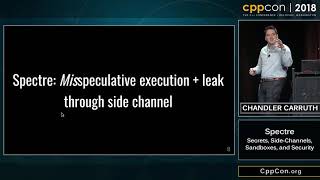 01h 28m“Spectre: Secrets, Side-Channels, Sandboxes, and Security”
 46mRethinking Architectures and Abstraction for a World Where Security Improvements Matter More than Performance Gains
 50mPractical Ghostbusting: Meltdown, Spectre and You
 48mSpeculative execution vulnerabilities
 33mGhosting the Spectre
 25mThe Memory of a Meltdown
 24mThe Memory of a Meltdown
 18mHardware-Software Codesign for Mitigating Spectre