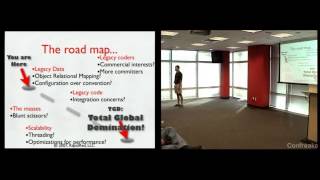
Keynote: Why Ruby?

summary
Argues that Ruby wins on concrete choices: language-level monkey patching and MIT licensing enable experimentation; Rails and GitHub produce collaboration and about 30 Rails applications across domains; concrete extensions like array.second and pluralization are added and deployed (sometimes controversial but usable). Claims testing culture and small syntactic features make code aesthetically consistent, and that freedom plus guidance — not heavy enforcement or static types — produces practical, productive results.
AI-written summary · about
chapters (43)
- 0:00Intro
- 0:20Show of hands
- 5:52Features
- 7:08Utilitarian
- 8:32Testing
- 9:20The Ruby Tribe
- 12:03Aesthetic
- 14:08Aesthetics
- 14:27Python
- 16:01Ruby
- 17:01Motivation
- 20:15assembler
- 21:35MIT License
- 22:25Freedom in Ruby
- 24:10Weird Freedoms
- 24:53Why to Become a Hero
- 26:03Marching Band
- 27:00Limits
- 27:23One Freedom
- 27:50Why Ruby
- 28:40Pluralization
- 29:57Array Extensions
- 34:53Jeff Atwood
- 36:20Freedom is scary
- 37:12Rope
- 39:13Security Theater
- 40:47Type Safety
- 42:34Stupid Programming
- 43:38Freedoms
- 44:13Monkey Patches
- 44:52More Good More Evil
- 46:19Ruby is Your Friend
- 46:48Its Up to You
- 48:46Scare Tactics
- 50:17Guidance vs Enforcement
- 50:38Cigarettes
- 52:07Food
- 53:39Predictive Consequences
- 53:59Prohibition
- 54:43No Good Sleep
- 55:00Consenting Adults
- 56:19Gambling
- 57:37Enforcement