Introduction to Machine Learning with H2O and Python
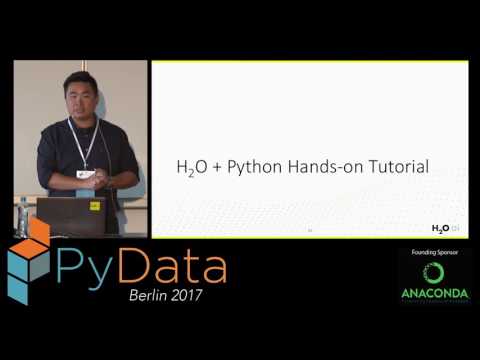
summary
Shows runnable Jupyter notebooks that actually start a local H2O JVM cluster and connect to a cloud node, import CSVs or convert pandas frames, and run models whose results appear in Python. Examples train GLM, GBM, DRF and deep‑learning from Python, then use grid and random search with cross‑validation and early stopping to tune hyperparameters. A stacking ensemble combines models and demonstrably lowers MSE and raises AUC. Includes the H2O jar deployment workflow so models export as Java and run on larger machines.
AI-written summary · about
chapters (13)
- 0:00Workshop overview
- 4:43H2O.ai platform intro
- 9:24H2O cluster setup and data import
- 16:52Data exploration in H2O
- 19:59Regression models training
- 28:28Classification models training
- 34:07Break and Q&A
- 34:29Model tuning techniques
- 44:18Cross-validation and early stopping
- 49:18Hyperparameter tuning methods
- 56:29Model stacking
- 1:00:24H2O cloud deployment
- 1:08:38Workshop recap
related talks
 01h 10mGetting started with H2O on Python
 44mScalable Automatic Machine Learning with H2O
 30mScalable Automatic Machine Learning with H2O
 01h 18mIntroduction to H20 AutoML with Python
 50mScalable Data Science & Deep Learning with H2O
 01h 26mMachine Learning Algorithms with H2o and PowerShell
 27mDeploying distributed AI and machine learning in financial services
 43mMachine Learning with R