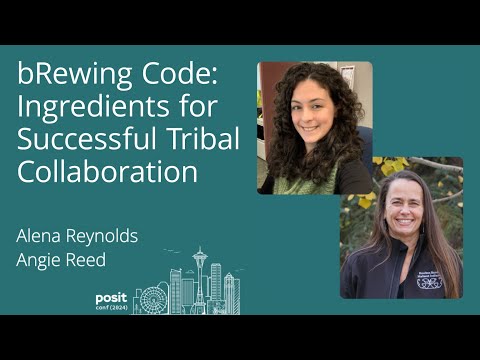
bRewing code: Ingredients for successful tribal collaboration
summary
Tribal water program uses R and R Markdown (moving toward Quarto), connects one whole database to reproducible scripts, and spends 60 hours of time plus 90 kg of supportive management in weekly one‑on‑one mentorship to produce a complete water quality assessment report. EPA‑funded Tribal Exchange Network Group provides technical assistance, code and narrative live in a single Rmd, outputs reproduce reliably, new coders gain confidence, and the collaboration spawns community artifacts (knitted coding mitts, custom illustration) that reinforce the process.
AI-written summary · about
chapters (16)
- 0:00Introductions
- 1:49Tribal coding exchange
- 3:41Purpose of tribal data work
- 4:24Water quality report recipe
- 5:52Ownership and data work
- 7:15Supportive management
- 8:50Time investment and autonomy
- 9:53Fun as ingredient
- 11:24Balancing fun and learning
- 12:50Roles in collaboration
- 13:54Combining ingredients
- 15:21Storing brewed code
- 16:25Expanding tribal coding
- 17:49OpenScapes and Alison Horst
- 18:56Design of data witches coven
- 19:59Closing thoughts
related talks
 20mSmall Team, Big Value: Using R to Design Visualizations
 17mHistory repeats itself: What the Du Bois Challenge taught me about reproducing design
 24mScaling up to synergy, one “Ops” at a Time
 01h 01mCommunity Leaders Roundtable
 22mMap-based tools for Māori communities
 22mTurning kick ass design into kick ass code
 30mMaking a Brand Programmable
 59mBabble & Dabble: Creating Bonds Across Disciplines