Capability Mapping
summary
Argues that microservices must align to business processes (not just vague domains) to get independent deployability and avoid the entity-service anti‑pattern. Recommends finding boundaries with value stream mapping and event storming, targeting processes or activities as services, using events/AMQP for low coupling and HTTP/gRPC when near‑real‑time is needed. Warns against nano‑services and ESBs, aims for roughly 80% product mode / 20% project mode so teams ship independently.
AI-written summary · about
chapters (24)
- 0:00Intro
- 0:29Agenda
- 1:54Why Microservices?
- 2:50Monoliths Do Not Scale To Many Teams!
- 6:50Microservices let us scale an organisation
- 8:36Independent Deployability
- 9:12Product Mode
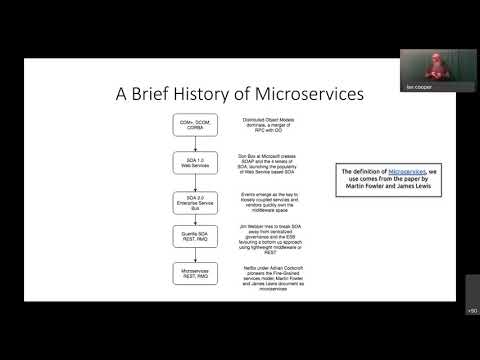
- 12:36A Brief History of Microservices
- 20:01Microservices are partitions of software
- 22:12Microservices require Common Closure
- 22:54Microservices need stable partitions
- 24:50Cohesion and Coupling
- 25:52Splitting Up Services
- 26:56SOA is Aligned to Processes
- 28:29Process & Capability
- 30:03Finding Processes
- 30:34Value Stream Mapping
- 38:55Guest Cycle
- 40:35Smart Endpoints and Dumb Pipes
- 42:17Multitudes, Multitudes
- 43:06Event Storming
- 48:33Microservices are Bounded Contexts!
- 50:33Inside the Microservice Boundary
- 52:40Across Microservice Boundaries
related talks
 01h 01mCapability Mapping
 42mCapability Mapping
 49mMicroservices: An unexpected Journey
 49mIdentifying and Scoping Microservices
 38mMicroservices, a bittersweet symphony
 30mThe Entity Microservice Trap: You May Be Doing It Wrong
 58mFinding your service boundaries - a practical guide
 01h 02mDesigning Microservices