Developing Software for Persistent Memory

summary
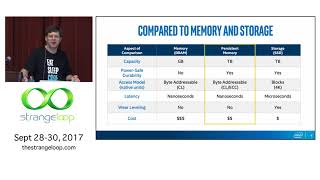
NVDIMM-style persistent memory maps directly into address space and needs cacheline flush and pcommit to guarantee durability; latency in the presenter’s simulator is 90 ns for DRAM vs ~200 ns for PM, so sequential scans lose ~7% but random B+ tree walks drop ~37%. A prototype DB keeps the primary copy in PM and rebuilds DRAM indices on restart: cold recovery is ~8s, making selective indices persistent drops recovery below 2s (80% less rebuild), full-persistence gives ~5 ms restart but ~30% throughput cost. Libraries like libpmem/pmemio abstract flush/fence logic.
AI-written summary · about
chapters (14)
- 0:00Intro
- 1:55Benefits
- 4:20Persistent Memory
- 11:46Sum Flow Chart
- 13:05Nmap
- 14:39Pitfalls
- 17:26New Ins
- 18:34Open Source
- 19:30Prototype
- 21:11Demo
- 22:14Evaluation
- 23:29Recovery Time
- 27:55throughput
- 28:34Summary
related talks
 43mPromise and Pitfalls of Persistent Memory
 17mPreview: Persistent Memory
 06mEarly experience of Utilizing Persistent Memory for Database... (Work-in-Progress Report)
 52mByte-Addressable Persistent Memory and DBMS
 01h 08mC++ and Persistent Memory Technologies, Like Intel's 3D-XPoint
 30mLarge-Scale Practice of Persistent Memory in Alibaba Cloud
 19mPangolin: A Fault-Tolerant Persistent Memory Programming Library
 25mDisaggregating Persistent Memory and Controlling Them Remotely