Accelerating Research with Competitions

summary
Describes differences between ML research problems and systems engineering, using examples like building a spam filter where a simple scalable algorithm (naive Bayes) yields poor real-world quality. Recommends accelerating ML research by running competitions to compare many modern methods quickly rather than exhaustively trying them in-house.
AI-written summary · about
chapters (15)
- 0:00Introduction to competitions
- 3:50Purpose of competitions
- 5:56How platforms work
- 8:03Successful competition examples
- 10:08Organizing tips
- 13:19Phone detection in photos
- 16:07Banned items by text
- 18:16Common organizing mistakes
- 20:49Participant solution process
- 23:13Metrics and leakage importance
- 26:05Model creation and validation
- 28:58Feature engineering and ensembles
- 31:51Competition tools
- 32:53Expected outcomes
- 34:47Q&A
related talks
 28mChallenges at the intersection of ML.
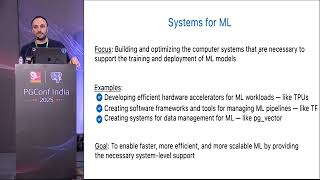 06mML for Systems and Systems for ML
 26mWhy Machine Learning Algorithms Fall Short...
 30mBuilding Teams and Culture that Support ML Innovation
 54mML Beyond Metrics: Challenges of Using ML Systems in the Real World
 01h 10mBayesian Optimization and Machine Learning for Accelerating Experiments in the Physical Sciences
 25mAutomating Operations with ML
 16mAmeet Talwalkar, Assistant Professor of Computer Science, UCLA @ MLconf SF Part 2