Demystifying the Mahabharata with GraphRAG
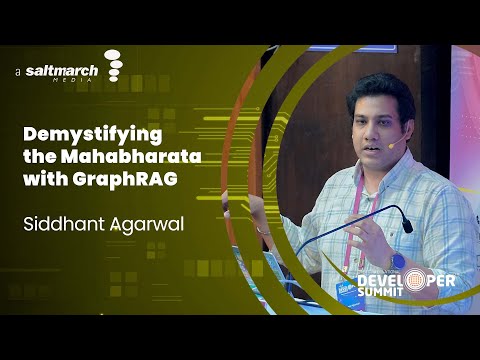
summary
A chatbot maps natural language questions to Cypher and a Neo Forj knowledge graph built from 18 Mahabharata PDFs (≈5,400 pages, ~2.7M tokens), converting text into vectors and extracted entities to create a combined lexical+entity knowledge graph. The dataset expands from 191 nodes to 51,000 nodes and from ~500 relationships to 500,000+ relationships. Vector RAG gives similarity dumps; GraphRAG enables multihop traversal and provenance, claims up to 3x accuracy and ~95–96% on one enterprise benchmark. Tools: Neo Forj, GraphRAG, Gemini/GPT, and LLM Graph Builder.
AI-written summary · about
chapters (15)
- 0:00Introduction and speaker intro
- 1:07What is Neo4j and graph databases
- 5:01Why Mahabharata for this project
- 8:36Building the Mahabharata graph manually
- 10:42Moving from manual to AI-assisted graph
- 12:28Challenges with unstructured data
- 13:32Introducing GraphRAG and vector databases
- 15:35LLM Graph Builder tool overview
- 17:21Scaling the graph and accuracy gains
- 21:35GraphRAG vs VectorRAG comparison
- 23:18How GraphRAG combines structured and unstructured data
- 25:55Live demo limitations and GraphRAG benefits
- 28:26Handling multimedia with metadata
- 29:29Chatbot evolution and LLM testing
- 30:39Tools, resources and closing
related talks
 17mFrom Ancient Epic to Modern Marvel: Demystifying the Mahabharata Chatbot with GraphRAG
 30mAgentic RAG with Knowledge Graphs Explained
 36mGraphRAG Explained 🔥 Building Smarter LLMs
 53mPractical GraphRAG - Making LLMs smarter with Knowledge Graphs
 26mPractical GraphRAG Making LLMs smarter with Knowledge Graphs
 24mEmpowering Lifelong Learning: Transforming Data into Insights With GraphRAG
 33mSmarter Industrial Fault Diagnosis with Knowledge Graphs and Large Language Models
 27mAdaptive Knowledge Graphs for Dynamic RAG Systems