Python and elasticsearch 101
summary
Covers integrating Elasticsearch with Python in a production stack, showing how Elasticsearch is used beyond search as a primary data store (using snapshot/restore features). Describes concrete use cases including storing business events and IoT device metrics and how those different usages are implemented.
AI-written summary · about
chapters (12)
- 0:00Intro
- 0:24WHAT IS ELASTICSEARCH You know, for search
- 1:36WHY DO WE USE ELASTICSEARCH • To store the full telemetry of all our MDM devices Position, actual speed, batteries metrics, alarms, temperature . To store business events to let operational know what happens in their service Events when a customer takes a car akandamentos facturation process
- 2:29SCHEMA-LESS? I've said Elasticsearch is schema-less. Yes, the schema is not enforced by the database, but you can define a mapping, a definition on the type of the data integer, String. Dates. Datetimes So data are organized in Indices, like a database in a classical RDEM. Each Index has one or more type which can be interpreted as a table You can ask the Elasticsearch for the mapping in a specific index, and man mapping
- 4:14DOCUMENT AND MAPPING I clearly enjoin you to prepare your index and create and manage the mapping yourself
- 4:57Elasticsearch stores data in Shard. Basically you have 5 shards per Nodes. Under the hood, Es will duplicate shards to one or multiple nodes. Also, Shards will balance shards on nodes to spread the search load
- 5:30INSERTING DATA . Using a river. A river is a kind of link between Elasticsearch and a service, for instance RabbitMQ, or Twitter . Using the index API. The Index API is globally a POST onto an index, and a PUT to modify an existing document. Note: There is also a bulk mechanism to index a lot of data
- 6:20Queries will be more complicated than just an exact match on a field to a value Query and Filter are the same, but query specify how well the results is good with a ranking
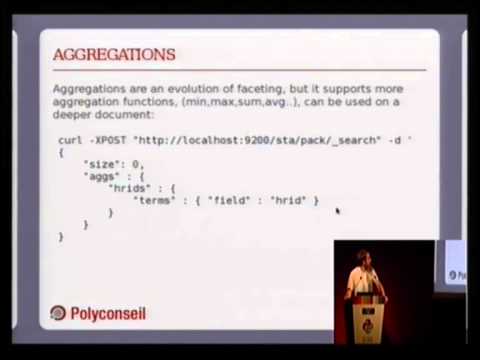
- 8:01Faceting can be imagined as a Group By with a count. It's extensively used in online store, when you fiter products by colors, brands, sizes... The page displays a counter of available products. The query will return both products results AND the facets (counts per brands for example)
- 9:50Elasticsearch use Lucene to extract information using tokenizers, and analize the text to store it correctly. Thus, ES is able to search if a document match other documents, and return results with ranking score
- 13:13ADMINISTRATIVE TASKS If your mapping changes, the data won't be updated, and you need to reindex all your data. Es provides an API to reindex your actual data to a new one: elasticsearch.helpers.reindex
- 14:21Elasticsearch comes with a lots of plugins you should use (HEAD). Rivers are also plugins (RabbitMQ River, Twitter River, Kafka river) There is a python script plugin to do python in your queries Elastic.co provides Shield and Marvel to adds security and monitoring to your cluster
related talks
 39mIntegrating and Testing Elasticsearch with Nontrivial Queries
 47mMake sense of your (big) data using Elasticsearch
 10mGetting Your Data into Elasticsearch: Let Me Count the Ways
 01h 01mBest Practices With Elasticsearch
 41mBetter Data Exploration and Visualisation with Elasticsearch and Kibana
 34mPython as a Framework for Analytics and Growth Hacking
 01h 00mElasticsearch: you know, for more than search
 49mElasticsearch, Logstash & Kibana