A FOSS Manifesto to Drive Open Source
summary
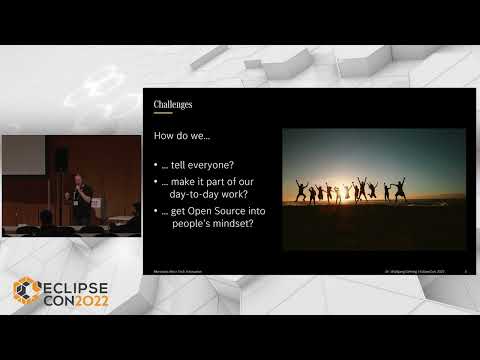
Mercedes‑Benz creates a company‑wide FOSS Manifesto and an OSPO, publishes the text under CC0, and embeds three company and four employee principles that explicitly allow use company time to contribute to open and inner source. Claims cited: 97% of new software relies on OSS, contributing firms get roughly twice the benefit, and only ~2% of OSS projects survive. Practical steps include mandatory training, two senior signatures, security checks, foundation memberships, and iterative culture change — adoption works but progresses slowly.
AI-written summary · about
chapters (19)
- 0:00Thought experiment
- 2:16Mercedes code-sharing struggles
- 5:27Cost of not sharing code
- 7:59Why contribute to open source
- 9:03Open source in company strategy
- 10:04Mercedes-Benz FOSS Manifesto
- 13:15Company principles of FOSS
- 16:42Employee principles of FOSS
- 21:17Sharing FOSS Manifesto
- 22:40Call to action
- 23:02Q&A
- 24:17Open source contribution rules
- 25:47Publishing open source projects
- 27:35Challenges with open source adoption
- 29:58Suppliers and open source
- 32:10Competitive concerns in open source
- 34:38Legal’s role in open source
- 35:46Sustaining open source projects
- 36:11Closing
related talks
 26mThe Mercedes-Benz FOSS Manifesto – Our Commitment to be Truly Open
 31mA Vision of FOSS @MercedesBenz
 37mA Vision of FOSS @Mercedes-Benz
 14mThe FOSS Manifesto at Daimler TSS
 27mOpen Source: Supporting, Contributing and Evangelising
 13mHow can we truly arrive at "open-source everywhere"?
 41mHow Your Company Can Help Sustain Open Source
 34mConsumers To Contributors: Open Source As a Competitive Advantage