Moving with the Android ecosystem towards a 64-bit r-Evolution
summary
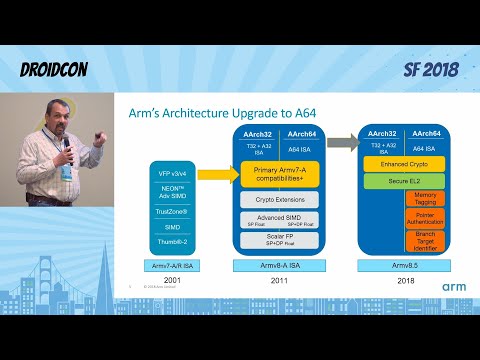
Google requires 64-bit builds for new and updated Play apps starting August 2019 and ARM shows concrete gains: 20% ART uplift for Java apps, native gains of ~7.5–15% in Geekbench, and a Unity demo yields a 12% frame rate gain with 200 agents. About 80% of current devices ship both ABIs and ~88% run Lollipop or later, app bundles and Play dynamic delivery plus Android Studio R8 shrinker mitigate larger APKs, and new 64-bit features add memory tagging and pointer authentication.
AI-written summary · about
chapters (14)
- 0:00Introduction and speaker background
- 1:54ARM’s 64-bit evolution and Android support
- 3:19Google’s 64-bit Play Store mandate
- 4:24ARM’s 64-bit hardware advancements
- 5:50Why developers should adopt 64-bit
- 8:20Security benefits of 64-bit Android
- 10:27Performance gains with 64-bit
- 12:55Use cases requiring 64-bit support
- 13:57Device compatibility and market trends
- 16:29Migration timeline and ecosystem updates
- 18:59Benchmarking 64-bit performance
- 22:15Live demo of 64-bit game performance
- 24:03Managing app size with 64-bit pointers
- 26:08Summary and call to action
related talks
 27mBig Android: Reaching the Masses! Adding X86 Support To Your Game
 24mBuilding an awesome game for Android
 08mKeep your app from failing in a 64-bit only world
 37mUnderstanding Android Runtime (ART) for faster apps
 55mCompilers. Dalvik. ART. And everything in between
 21mPrepare your app for the 16 KB page migration
 39mWhat's new in Android Runtime
 13mCultivating Your App: Planting the Seeds for Android 16 Success