The way to modularization

summary
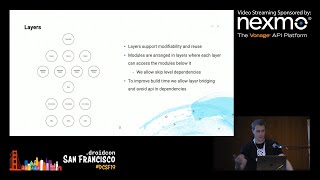
Large Delivery Hero app moves from one monolith to a deliberately modular codebase with 60+ modules supporting 6 apps and 3M+ daily users, splitting code into core vs feature modules to improve ownership and dependency control and to cut incremental and clean build times by letting Gradle build modules in parallel. Implementation uses MVVM, a translation processor, Retrofit and Dagger, exposes per-feature DI config interfaces for lazy provisioning and proxy interfaces for cross-module navigation, rejects eager Hilt integration for now, and keeps tests passing throughout the migration.
AI-written summary · about
chapters (18)
- 0:00Introduction
- 1:18Speaker introductions
- 3:07Background and growth
- 8:01Why modularize
- 10:12How we modularize
- 11:58Challenges faced
- 15:30Future improvements
- 18:16Code workshop setup
- 25:04Modularizing localization
- 27:22Core module extraction
- 32:47Moving test utilities
- 36:03Common dependencies
- 37:29Restaurant provider module
- 45:46Config module extraction
- 50:09Feature module RLP
- 1:08:22Feature module RDP
- 1:15:40Final app structure
- 1:18:34Q&A session
related talks
 01h 12mRound table. Modularization 2021
 40mModularizing Android Applications
 37mA Complete Journey of Android Modularisation
 27mModularising the right way
 20mBreaking Down Modularization
 35mThe Great Modularization: How We Scaled a 15-Team React Native App Without Losing
 32mBuild a modular Android app architecture
 20mStarting Module Separation from New Feature Development