Scaling Cloud Development Environments on K8s: Enterprise-Scale Adoption Lessons

summary
Kubernetes-based cloud dev environments are treated as Kubernetes custom resources, using the DevWorkspace Operator and the Devfile spec to standardize workspaces; a fleet-of-clusters approach and predictive scaling (KEDA, CAPA) handle user growth. Operational findings: roughly 600 objects contribute 2.5 GB to etcd, default etcd tops at ~8 GB, and heavy CSV/configmap replication explodes state. Fixes include a cleanup cron job, disabling copied CSVs, and per-release load tests that create 1,000 concurrent workspaces.
AI-written summary · about
chapters (19)
- 0:00Introduction
- 3:10Why Kubernetes for development environments
- 6:22Scaling limits and multi-cluster
- 8:11Predictive scaling and auto-scaling
- 8:31Eclipse Che internals and DevWorkspace
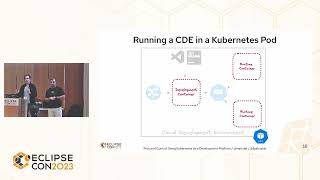
- 10:59Cloud development environments as Kubernetes objects
- 11:42ETCD pressure and stability
- 13:09ETCD incident analysis
- 14:34ConfigMap and OLM overhead
- 16:45Load testing and release confidence
- 17:48Q&A
- 20:18IDE usage trends
- 22:44Next versions and workflow
- 24:10Customizations and VS Code
- 27:23Persistent storage and user state
- 28:48Service sharing and communication
- 30:12Terminal vs IDE resources
- 32:44ETCD load impact
- 33:49Summary
related talks
 36mOptimizing Resource Usage in Kubernetes
 35mPros and cons of using Kubernetes as a development platform
 27mMaximizing Developer Productivity in Kubernetes
 15mDemo: Resource(Cost) optimization on planet scale Kubernetes clusters.
 34mCreating Multistage Development Environments with a K8s Cluster of 8000 Pods and Growing
 38mScaling Kube-Apiserver to Thousands of Tenants – Lessons Learned From kcp
 40mBeyond Productivity: Scaling Cloud Dev Environments for Faster Feedback & Sustaina...
 46mScaling EDA Workloads with Kubernetes, KEDA & Karpenter