Kernel Module Management in Software-Defined Storage
summary
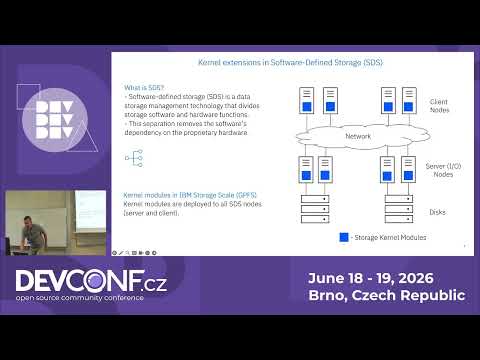
Kernel storage extensions for GPFS consist of three kernel modules that implement VFS hooks, inode and file operations, architecture-specific code and POSIX ACLs, and each traditional build produces three .ko files in about 20–30 seconds. The KMM operator automates building with build pods, pushes module artifacts as container images in a registry, manages per-node kernel-version mappings, uses node selectors to target nodes, and deploys driver containers to load modules across Kubernetes/OpenShift clusters.
AI-written summary · about
chapters (10)
- 0:00Kernel module management intro
- 1:06Linux VFS and storage extensions
- 3:17GPFS kernel functions
- 5:26Traditional deployment
- 6:54Portability layer in SDS
- 7:15Modules in containerized SDS
- 8:16KMM Operator overview
- 10:04KMM config and deploy
- 11:07Traditional vs KMM
- 11:49Summary and future
related talks
 22mPersistent Memory in Kubernetes
 36mKubernetes Distributions and 'Kernels'
 37mStorage on Kubernetes - Learning From Failures
 32mUnderstanding Kubernetes Storage: Getting in Deep by Writing a CSI Driver
 35mKubernetes Storage Lingo 101
 29mSo, What If I Don’t Want My Persistent Storage To Be Yet Another Bindmount?
 36mRunning High-performance User-space Packet Processing Apps in Kubernetes
 05mLightning Talk: Managing Drivers in a Kubernetes Cluster