"The Evolution of C++ Past, Present and Future"

summary
C++ evolution focuses on concrete wins: concepts in GCC 6.1 lets templates express and check requirements with clearer errors and faster compilation; modules reduce a single-translation overhead from ~176 bytes of source to 400KB–1MB of compiler work and promise large compile-time savings; coroutines, ranges and networking TSs are in use now; guideline work reaches 423 rules to steer safer, zero‑overhead code toward type and resource safety; the claim is that combining modules, concepts and library TSs yields substantially faster builds and clearer, more maintainable code.
AI-written summary · about
chapters (15)
- 0:00Introduction and overview
- 1:07Why C++ succeeded
- 9:01Roots of C++ and its design
- 13:32Choosing abstraction levels in C++
- 20:10What matters in software development
- 25:30Major versus minor language features
- 30:19Developer vs designer perspectives
- 35:49Balancing community and innovation
- 43:55Direction and principles for C++
- 51:34Future goals for C++
- 1:00:21C++17 features and limitations
- 1:05:01Concepts and modules introduction
- 1:13:40Modern C++ guidelines and tools
- 1:23:35Summary and call to action
- 1:25:48Q&A session
related talks
 59mThe Best Parts of C++
 01h 00mConcepts in C++20: Revolution or Evolution
 01h 39m“Thoughts on a more powerful and simpler C++ (5 of N)”
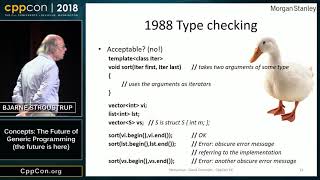 01h 39m“Concepts: The Future of Generic Programming (the future is here)”
 58mWhat is C++
 01h 13mC++ Templates Revised
 52mConcepts: The Future of Generic Programming
 50mExpression Templates: Past, Present, Future