“#include <os>: from bootloader to REST API with the new C++"
summary
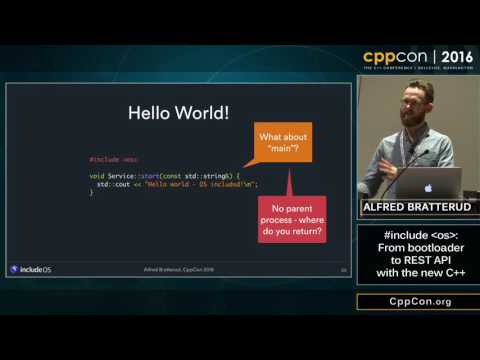
IncludeOS compiles a modern C++11/14 service into a minimal bootable VM image (about 1 MB image) that runs on Linux, Windows or Mac and boots in roughly 300 ms boot; the project implements drivers and a full network stack (Ethernet, ARP, IP, UDP, TCP) with no blocking POSIX calls and an event loop that is single-threaded by default. A web server framework, Acorn REST framework, is built on top, shows live stack sampling and metrics, and benchmarks ~11% faster than Apache and ~79% faster than Node for simple workloads; deploys to OpenStack.
AI-written summary · about
chapters (18)
- 0:00Introduction to IncludeOS
- 2:59What are Unikernels
- 6:16Hardware virtualization
- 9:38Build system and C++
- 12:20Hello world and delegates
- 15:03VGA and device drivers
- 18:46Kernel core and interrupts
- 22:46Custom IP stack
- 26:29Single threading and async
- 28:34Building a TCP server
- 30:11Security features
- 32:16Acorn web framework
- 34:19Live diagnostics
- 38:09Routing and middleware
- 43:22Performance benchmarks
- 45:39Cloud deployment
- 46:21Future roadmap and closing
- 49:21Q&A
related talks
 45mIntroducing OSv: A New Open Source Operating System for the Cloud
 41mOSv: Probably the best OS for Cloud workloads you've ...
 39mOSv: Probably the Best OS for Cloud Workloads You've Never Heard Of
 26mComposer: Building OS images for any platform
 33mUnikernels and Explorations
 33mBootable Containers: An entire OS as a Containerfile
 36mOpenPOWER and GPU Porting Platform for FOSS Using OpenStack at OSUOSL
 06mPOWER your Cloud