A Scalable, Ensemble Approach for Building and Visualizing Deep Code-Sharing Networks
summary
An ensemble system estimates code sharing by combining instruction engrams, dynamic API traces, PE/header and byte-sequence features, and then compresses counts with an approximate feature counting plus feature-hashing trick so feature extraction and lookup run on commodity hardware. A probabilistic nearest-neighbor index avoids quadratic all-pairs comparisons, returning only high-probability matches. Evaluated by MIT Lincoln Laboratories against four competitors and scoring highest, the pipeline ships with a Python ML library and a web-based visualization for exploring millions of malware binaries.
AI-written summary · about
chapters (5)
- 0:00Start
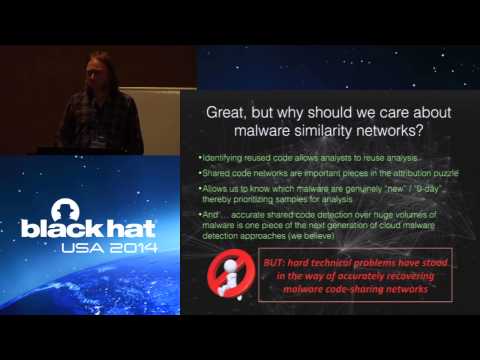
- 5:43Great, but why should we care about malware similarity networks?
- 9:01Problem 2: Scale
- 11:40Here's what it looks like when we compute the bag of features model using PE header features
- 15:58Our third innovation
related talks
 31mAn AI Approach to Malware Similarity Analysis: Mapping the Malware Genome With a Deep Neural Network
 30mData Driven Security
 30mEnhancing CTI Processes with Code Search Technology
 40mDemystifying File Similarity for Malware Detection
 25mEnhancing Malware Code Similarity Detection through Vectorsearch and TLSH
 31mUsing Math to Speed Up Security Assessments of Windows Executables
 44mApplied Machine Learning for Data Exfil and Other Fun Topics
 16mCodeExtract: Enhancing Binary Code Similarity Detection with Code Extraction Techniques