Will your infrastructure support your ML initiatives?

summary
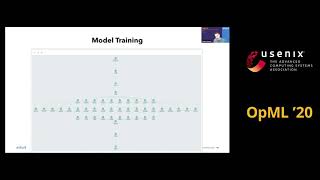
Covers a concrete pipeline: an open JSON spec called Catalyst ML (about 85 transformation operations, with a Python API that exports a SageMaker-ready artifact) that the app runs via FlowGo on AWS Lambda to perform feature engineering then call a TensorFlow model; the model expects a 30×1 input matrix, the Lambda end-to-end invoke (transform plus inference) runs in ~3.46 ms and uses ~47 MB of memory, and the open-source pieces successfully execute the real-time flow.
AI-written summary · about
chapters (16)
- 0:00Intro
- 0:16Agenda The rise of machine learning
- 1:02The rise of ML
- 1:53Goodbye software?!
- 2:32Does this mean ML is always the answer?
- 3:34ML, AI, neural networks, and deep learning
- 7:40ML: Applications
- 9:36What's a dev gonna do?
- 14:31Introducing...
- 23:13New application architectures
- 24:33Event-processing premise
- 30:31Machine learning capabilities
- 31:34Serverless means...
- 34:12Serverless applications
- 44:54Four key principles to embrace
- 46:25Getting started
related talks
 26mManaging ML Models @ Scale
 43mMachine Learning Engineering principles with Python and MLFlow
 41mInfrastructure for ML Applications
 32mAutomating Production Production Level Machine Learning on AWS
 12mLeveraging AWS and Kubernetes for Scalable AI/ML Workloads in the Cloud
 18mAutomate the boring ML stuff with pipelines
 24mMLflow: An open platform to simplify...
 26mRunning Secure AI/ML Experiment in a Unified MLOPS-DevSecOps Pipeline