What Breaks When You Build AI Under Sovereignty Constraints
summary
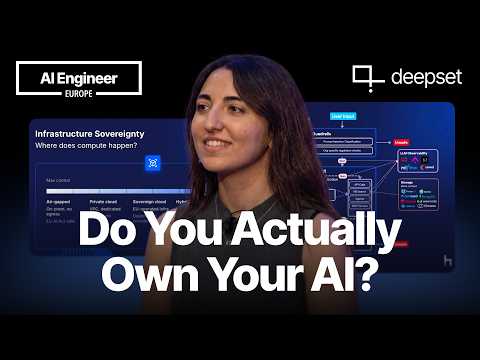
Claim: sending EU citizen data to an embedding API in Virginia violates GDPR. The talk drills four sovereignty pillars — data, model, infrastructure, operations — and shows what actually breaks when each is retrofitted: swapping a frontier API for a self‑hosted model forces full performance re‑evaluation and prompt rewrites; moving private data spawns multiple jurisdictional databases and search routing headaches; ripping managed infra on‑prem exposes hidden vendor lock‑in and GPU/network gaps. Demonstrated stack: Haystack, OpenTelemetry, BM25, local Mistral/Google/Nvidia models; closing checklist: swap models without changing application logic, reproducible run logs stored in a compliant location, and can the team respond to incidents without a hyperscaler.
AI-written summary · about
chapters (6)
- 0:00AI sovereignty constraints
- 2:02Sovereign AI pillars
- 7:21Retrofitting sovereignty pitfalls
- 9:51Orchestration for sovereignty
- 13:21Sovereign agent with Haystack
- 17:52Sovereignty checklist
related talks
 28mWhy Private AI Matters: Data Sovereignty as the Foundation for Trustworthy AI on the Open Web
 20mSecuring generative AI: Privacy and compliance considerations
 40mGDPR in practise - Developing models with transparency and privacy in mind
 01h 10mNavigating the Interface Between the AI Act and GDPR Combining Innovation and ..
 38mIs My AI Racist? Or How Not To Break The Law With Machine Learning
 42mDefense against the dark arts of AI: The playbook for a sovereign model-as-a-service platform
 53m10 Key Challenges for AI within the EU Data Protection Framework
 15mA Comprehensive View of the Sovereign Data Ecosystem