How Stoic Perspective Empowers Agile Leadership

summary
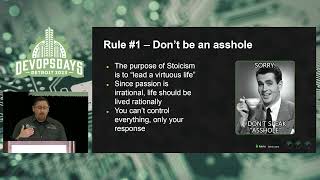
Asserts that meaning is a condition of survival and that three Stoic practices — prosoché (mindful attentiveness), arete (definition of done as non‑negotiable quality), premeditatio malorum (negative visualization) — give concrete habits leaders can teach. Treats teams as communities with rituals (standups, retros, mentoring, liberating structures) and recommends participant observation, stoic workshops and intentional retreats as tools that reduce burnout faster than adding metrics. Cites Stoics, Simon Sinek, Viktor Frankl and Brené Brown as theoretical anchors.
AI-written summary · about
chapters (16)
- 0:00Humanities in tech leadership
- 2:58Renaissance of humanities in tech
- 5:32Surviving uncertainty with meaning
- 7:18Meaning for agile team survival
- 9:06Control versus adaptability in Agile
- 10:14Teams as communities
- 11:00Anthropology for agile leadership
- 13:30Anthropology quotes for Agile
- 14:11Participant observation lesson
- 15:17Stoicism for modern leadership
- 16:21Stoic practices for Agile teams
- 17:27Stoicism and servant leadership
- 18:11Rediscovering humanity
- 18:54Intentional collaboration in hybrid teams
- 19:57Authentic connection through retreats
- 20:41Q&A
related talks
 05mSpacetime Management: Lessons from the Stoics
 44mMindful Agile Leadership - the Pillars of Success
 41mArchitecture in ACTion: Impactful Mind Skills for Tech Leaders
 24mModern Stoicism: How practice discipline and stay calm during the crisis
 31mCode, Calm, and Control Stoicism in Software Engineering
 29m The three things you should know about Agile Leadership
 05mSpacetime Management: Lessons from the Stoics
 38mMindful Agile: The Foundation of How We Grow