USEC: A User-Requirement-Driven Mandatory Access Control Framework for Operating Systems

Talkat 20th USENIX Symposium on Operating Systems Design and Implementation (OSDI '26) · 2026-07-13..07-15·
summary
Implements a Linux security extension that anchors policies at protected files, sockets and device nodes instead of process domains, compiles those templates to retained LSM hook bitmaps, and uses a cached decision path so unrelated syscalls skip the MAC engine. Policies are up to 10× fewer lines and runtime cost is 3.4%–17.1% lower than SELinux across server and desktop workloads. Uses binary-compatible LSM interfaces, integrates with existing modules, and is deployed by 210+ vendors on over 8,000,000 endpoints.
AI-written summary · about
chapters (8)
- 0:00USEC framework intro
- 3:54Deployable MAC research question
- 8:39USEC core design ideas
- 15:34Implementation and evaluation
- 16:36Policy complexity results
- 18:02Runtime overhead findings
- 18:42Compatibility benefits
- 19:04Q&A
related talks
 31mOverview and Recent Developments: SELinux
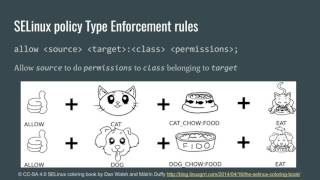 49mSELinux introduction
 19mSELinux Update
 28mOverview of the Linux Kernel Security Subsystem
 43mIntegrity Policy Enforcement: Full System Integrity Verification
 34mTying EVM into LSM Policy
 30mFinding Imposter Among Us: Container Edition
 11mSubsystem Update: State of SELinux, 2019