Overview and Recent Developments: SELinux

summary
SELinux presents a flexible mandatory access control model with a separate policy language and kernel enforcement, used by Fedora (targeted/strict/base) and Android (~2 billion devices); labels live in xattrs or on mount options for non-xattr filesystems, and the kernel manages labels and enforcement. Recent work adds access-controls for BPF, SCTP-specific hooks and socket peer labeling, userland gains batched semodule/semange features, the reference policy moves to GitHub hosting, and mailing lists migrate to vger.kernel.org.
AI-written summary · about
chapters (9)
- 0:00Intro
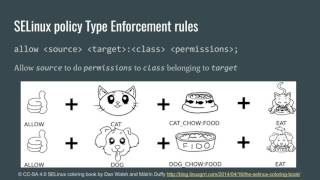
- 0:44Flexible Mandatory Access Control
- 5:53SELinux System Components
- 13:49SELinux Advantages
- 21:33SELinux kernel Contributors
- 22:16SELinux Userspace Changes
- 23:47SELinux Userspace Contributors
- 24:22SELinux Reference Policy Changes
- 26:25SELinux Policy Contributors