African Polyphony & Polyrhythm

summary
Argues that code models Simha Arom’s Central African polyphony and polyrhythm by building executable realizations: a three-drum piece aumo reconstructed from explicit variation rules, a wind ensemble for 18 musicians that uses descending pentatonic scales and octave “big” copies, and a comparison to Steve Reich’s phasing. Implements models in Clojure + Overtone + SuperCollider, indexes scales with MIDI and key functions, preserves non‑deterministic variation, omits choir synthesis because tonal‑language coupling and unequal temperament aren’t captured; generated audio demonstrates the method and invites validation by tradition bearers.
AI-written summary · about
chapters (14)
- 0:00Introduction to the book
- 1:20Musical encounter
- 3:24Recording challenges
- 5:30Musical modeling
- 8:00Analysis and ethnography
- 10:33Computational approach
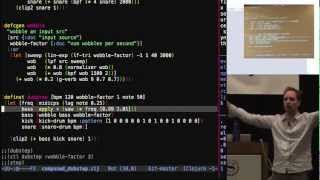
- 12:30Modeling drum patterns
- 16:54Clapping music analogy
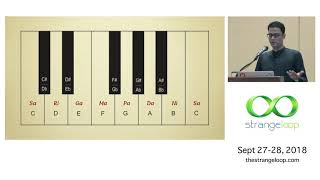
- 19:37Modeling pitch and scales
- 22:13Pentatonic scale systems
- 25:51Horn ensemble simulation
- 28:53Complete piece performance
- 33:00Compilation and philosophy
- 37:11Conclusion and Q&A