Designing an Autonomous Workbench for Data Science on AWS
summary
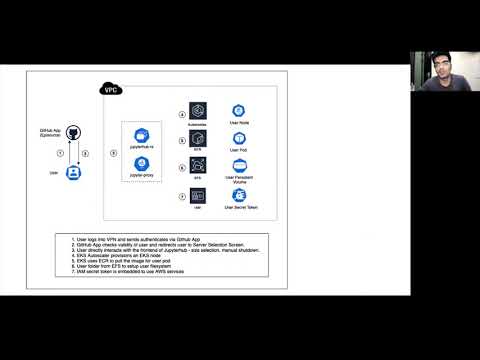
Built a self-service ML workbench using JupyterHub on AWS EKS with KubeSpawner to provision notebook servers, EFS persistent volumes per user, and node pools that autoscale for CPU/GPU workloads. Per-user Kubernetes service accounts map to dedicated IAM roles so access to datasets and S3 is least-privilege, with encrypted-at-rest EFS and idle shutdown to cut cost and ops toil. Results: faster experiment turnaround, easier sharing of notebooks and model checkpoints, and iterative adoption after user feedback.
AI-written summary · about
chapters (9)
- 0:00Intro
- 0:57Shortcomings of shared dev environments
- 2:07Key Features
- 3:25Arriving at the right picture
- 7:00User Storage
- 7:55User Management
- 8:45User Access Control
- 9:38How the workbench has helped ML teams
- 11:11Key Takeaways
related talks
 36mBuilding a Scalable Data Science & Machine Learning cloud using Kubernetes
 39mHow We Hosted 200+ Data Scientists in a K8S Cluster
 14mBuilding a high-performance analytics ecosystem on Amazon EKS
 12mLeveraging AWS and Kubernetes for Scalable AI/ML Workloads in the Cloud
 18mMatching Tools to Titans: Tailoring Posit Workbench for Every Cloud
 48mVending Machine for Accelerating Data Science Experiments
 41mBuilding a modern data platform on Amazon EKS
 35mCase Study: AI-as-a-Service on Kubernetes at Scale and In Production