Building private and secure applications easily.

summary
The Sunscreen FHE compiler compiles Rust into programs that run on encrypted data, auto-generating BFV parameters and a runtime that produces keys and ciphertexts. Supported types include unsigned/signed integers, fractional and rational numbers; demos include mean/variance over encrypted arrays, private ML inference (a three‑layer neural net and logistic regression on AWS), and a blind auction with 92 simulated bidders. It uses BFV for arithmetic today and is adding TFHE for fast comparisons; limitations: no strings, fixed-size arrays, noise growth and parameter limits.
AI-written summary · about
chapters (12)
- 0:00Introduction to private applications
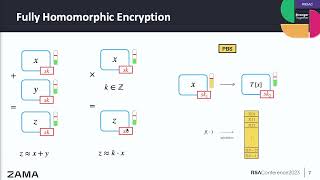
- 4:15Fully homomorphic encryption explained
- 7:48Challenges with current FHE setups
- 9:33Sunscreen compiler overview
- 12:00Supported data types in Sunscreen
- 14:30Testing encrypted and plaintext code
- 16:57Restrictions and limitations
- 20:47Statistics on encrypted data
- 23:35Private machine learning inference
- 26:02Blind auctions with FHE
- 28:30Benefits of Sunscreen compiler
- 29:56Q&A session
related talks
 20mAugmenting EVMs with FHE to Enable New Use Cases
 52mMachine Learning over Encrypted Data with Fully Homomorphic Encryption
 23mBootstrapping Homomorphic Encryption via Functional Encryption
 38mPrivacy in the Open Source: Homomorphic Encryption
 47mHomomorphic Encryption
 40mTrust No One
 29mProgramming machine learning algorithms in hardware, sanely, using Haskell and Rust!
 20mDeep Dive into Privacy Enhancing Technologies