Rust, In Sickness & In Health
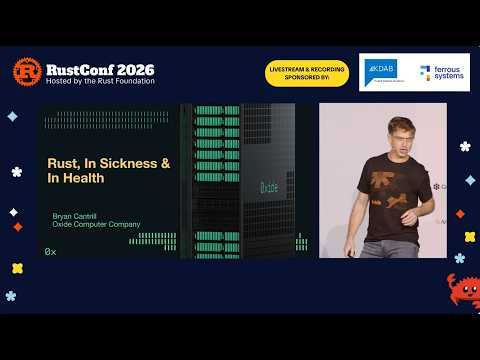
Talkat RustConf 2026 · on Thursday, 2026-09-10· at 09:00· Room 511 | Palais des Congrès de Montréal, Palais des Congrès de Montréal·
summary
A company built a rack-scale machine using Rust end-to-end, raising funds in 2019 and shipping hardware in 2023, and uses Dropshot for API servers, Progenitor for client generation, a micron kernel called Hubris plus a Humility debugger, and Hon for postmortem async inspection (open sourced). Rust code beats a C predecessor because B‑tree choices outperform the old AVL design. Production pain points center on async cancellation safety (RFDs 397 and 400) and a single reproducible future lock incident (RFD 609) despite widespread success across stack layers.
AI-written summary · about
chapters (18)
- 0:00Introduction and marriage metaphors
- 1:08Bad breakup with NodeJS
- 3:05Discovering Rust in 2018
- 7:07Founding Oxide Computer Company
- 10:58Rust as cultural beacon
- 12:10Choosing host operating system
- 13:15Rust community challenges
- 14:46Protracted Rust honeymoon
- 16:36Rust after the honeymoon
- 17:25USDTRace and instrumentation
- 18:06Marital tribulations in async Rust
- 21:07Progenitor and API versioning
- 21:51State map and Tokyo bug
- 22:37Updating systems over air gaps
- 23:21Future lock mystery illness
- 24:27Hon post-mortem debugger
- 25:38Rust’s cognitive load shift
- 27:16Future of Rust and warnings
related talks
 35m"A Hitchhiker’s Guide to Adopting Rust at Your Company"
 22m"Rust Training at Scale"
 26mPiecing together Rust: It is more than just writing code
 27mRust for Freshmen
 05m"Panic-Free Companies: Applying Rust [...]”
 06m“Your Senior Rust Coding Colleague”
 13mGetting hired in Rust - Recruiter's perspective
 29m"Scaling a Rust Community: Lessons from the Frontlines"