Open Source Component-Based Modeling with ModelingToolkit

summary
ModelingToolkit composes equation-based components, performs symbolic structural simplification and generates Julia code that plugs into fast differential-equation and nonlinear solvers with AD and custom GPU kernels. Claimed performance hits range from about 10× faster than JAX for Python→Julia JIT use up to 20–100× GPU speedups for domain-specific kernels. An industrial case (Instron/ITW hydraulics) refines control-modeling and cuts a multi‑million‑dollar machine’s hardware by roughly half while preserving behavior.
AI-written summary · about
chapters (14)
- 0:00ModelingToolkit intro
- 1:04Component-based modeling
- 3:16Model composition challenges
- 5:03How ModelingToolkit solves it
- 7:12ACSM fundamentals
- 10:02Equations to solvers
- 13:11Defining ACSM components
- 16:01Conserved physics properties
- 18:50Symbolic computation & codegen
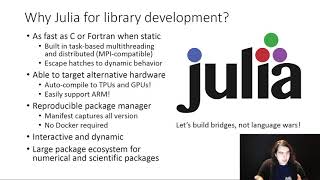
- 20:11Why Julia for ModelingToolkit
- 21:35GPU acceleration
- 22:37Instron case study
- 24:41Hardware & cost impact
- 25:24Python integration & Q&A
related talks
 27mJulia (workshop)
 32mhow compiler smarts can help improve the performance of numerical methods
 01h 37mTech Tutorial: Use Julia for your next scientific computing job!
 01h 27mIntroduction to Julia for Scientific Computing and Data Science
 36mAccelerating Differential Equations In R and Python
 01h 28mA Tour of Julia
 43mJulia: A Fresh Approach to Machine Learning
 01h 10mJAX: accelerated machine learning research via composable function transformations in Python