Walled gardens for growing students
summary
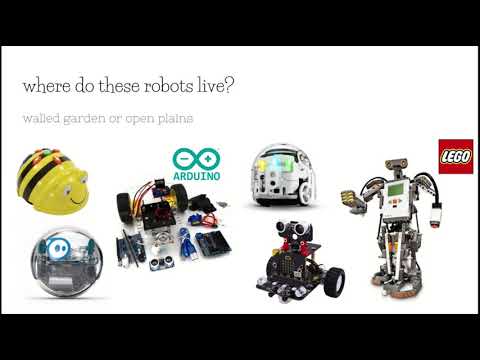
Argues that environments sit on a walled‑garden ↔ open‑plain spectrum and that teaching works by moving students along it. Shows concrete pipeline: Python blocks → MicroPython → full Python, using micro:bit, Sphero, Arduino and JSON HTTP APIs with the requests library, Flask web servers and a custom Nexus messaging API to avoid OAuth. Describes an 8‑day camp where dozens of Year 10–12 students build virtual assistants that actually deploy and respond to webhooks, and reports that staged scaffolds let novices complete real, working projects.
AI-written summary · about
chapters (14)
- 0:00Start
- 2:50my programming experiences walled gardens
- 6:41younger students?
- 7:17older students?
- 8:49which is better for transitioning?
- 9:54go with the flowchart
- 14:55project goals
- 15:34python and the web
- 16:11connecting to APIs
- 17:24connecting to voice/text interfaces
- 18:49programming concepts
- 19:17deploying a server
- 19:34conclusions
- 20:27questions?
related talks
 30mUsing Python, Flask and Docker To Teach Web Pentesting
 48mEvolving Security Experts Among Teenagers
 24mContained Intelligence: Secure Sandboxing for Gen AI Code
 16mHow to keep your server alive AND teach JS to kids
 28mJailbreaking and Securing LLM Apps: Lessons from an online wargame experiment
 38mWhy, and how you need to sandbox AI-Generated Code?
 40mConstruction Time Again: A Lesson in Paving Paths for Security
 19mBreaking Barriers: The Art of (Free) Gamified Security Training