Deceptive Security using Python
summary
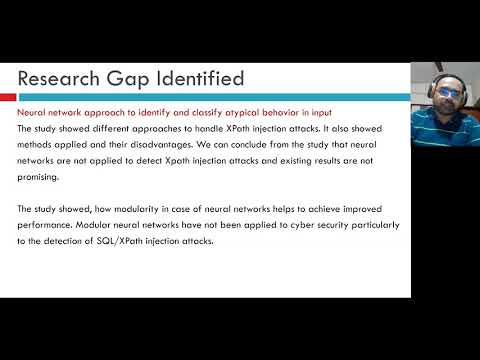
A Python deception stack implements WebTrap and DemandHunter to serve cloned login pages and honeynets, plus a classifier built with PyBRAIN LSTM modular neural networks and a count-based validation prefilter to detect XPath injection. The pipeline redirects malicious input to fake XML resources (fakedata.xml), logs attacker fingerprint data, trains with resilient propagation, and reports >90% classification accuracy and ~1s response time versus 1.5s for a single network.
AI-written summary · about
chapters (19)
- 0:00Intro
- 1:21Deception - Basic Idea
- 3:14Deception - Evolution - Advantages
- 5:42Demon Hunter
- 6:10Why we developed deception tool
- 6:53Problem Definition and Proposed Solution
- 7:31Introduction to XPath Injection
- 8:37Research Gap Identified
- 9:27System Design
- 11:07Algorithm
- 14:02System Environment
- 15:02Results (True Positives)
- 15:28Results (False Positives)
- 15:38Results (True Negatives)
- 16:08Summary of Results
- 16:56Snapshots (valid input scenario)
- 17:06Snapshots (malicious input scenario)
- 17:40Snapshots (fake login scenario)
- 17:54Conclusion
related talks
 35mCyber Deception 2.0: Adaptive Honeynets and Canary Intelligence in Production
 51mDeepPhish: Simulating Malicious AI
 31mWeb Application Honeypot Threat Intelligence
 23mHoneypots 2.0: A New ‘Twist’ on Defending Enterprise Networks
 31mAI-Powered Solutions for Cybersecurity
 51mDeepPhish: Simulating Malicious AI
 32mHey Attacker! I Can See You!
 26mLooking at 4 years of web honeypot attacks: tactics, ...