λS: Computable Semantics for Diff'ble Programming with HO Functions and Datatypes
summary
A new differentiable programming semantics, λS, gives computable meanings for higher-order derivatives and for nondifferentiable ops via the Clarke derivative, with primitives for integration, root finding and optimization and an embedded Haskell implementation that computes arbitrary-precision intervals up to a user tolerance. The language represents every function as an infinite derivative tower, evaluates minimization and min01 correctly (derivative converging to −2 in the clearance example), supports differentiable ray tracing and measures, and produces guaranteed interval enclosures rather than floating-point guesses.
AI-written summary · about
chapters (23)
- 0:00Intro
- 0:19Contributions
- 1:31How to differentiate through...?
- 3:31As: arbitrary precision
- 4:10As: libraries for differentiable programming.
- 5:15Outline of this talk
- 8:49We can compute higher-order derivatives
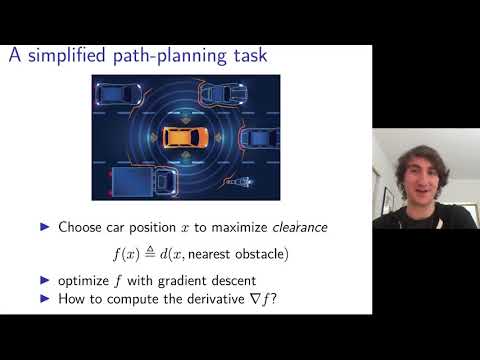
- 9:31A simplified path-planning task
- 10:19Simple clearance example
- 11:15An example no preexisting semantics could handle
- 15:48A first-order semismooth language
- 16:35First-order functions are streams of kth derivatives
- 18:20Second-order functions are transformers of first-order functions
- 19:04integral01 : constructive semantics
- 21:18Internal first-order functions continuous maps are stream transformers
- 22:00What is the derivative of ReLU?
- 23:56Implicit surfaces: example task
- 25:21We can compute the brightness of the reflected light
- 25:38A differentiable ray tracer
- 27:10Generalized parametric surfaces: example task
- 28:20Minimizers support convex hulls
- 28:49Probability distributions: example task
- 29:31Computing mean and variance
related talks
 06mDistribution Theoretic Semantics for Non-Smooth Differentiable Programming
 13mFormalizing a First-order Differentiable Logic with MathComp
 19mSemantics of Integrating and Differentiating Singularities
 49mSemantic Foundations for Probabilistic Programming
 39mDifferentiable Functional Programming
 18mA Language and Smoothed Semantics for Convergent Stochastic Gradient Descent
 34mDifferentiable Functional Programming
 36mProgramming Languages for Automatic Differentiation: What Now?