Automatic Differentiation in PCF
summary
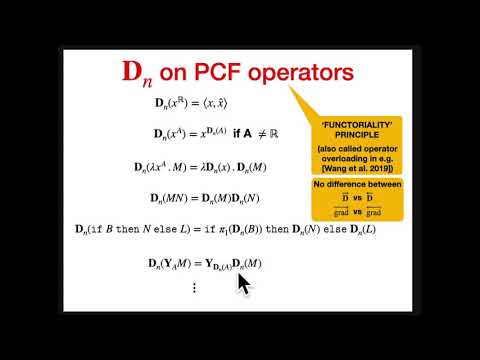
Proves that automatic differentiation on PCF with reals (higher-order, Turing-complete) is correct except on a Lebesgue-measure-zero set: forward and reverse AD compute true gradients forward and reverse mode. Builds a functorial program transformation D and shows errors lie among unstable points, characterized as a countable union of zero sets (more generally a quasi-variety) under the hypothesis that primitives form an admissible clone. Gives the ReLU-if counterexample (wrong at 0) and a constructive proof using logical predicates and an extrusion lemma.
AI-written summary · about
chapters (12)
- 0:00Introduction
- 2:38Notation
- 5:15Part I
- 14:18Soundness
- 16:44Hidden Mistake
- 19:16Our Contribution
- 19:45Main Result
- 22:34Proof
- 23:16Stable and Unstable Points
- 25:17Proof by Contraposition
- 26:40Proof by logical predicate
- 27:34Literature review
related talks
 36mProgramming Languages for Automatic Differentiation: What Now?
 29mPartial Evaluation of Automatic Differentiation for Differential-Algebraic Equati...
 11mAbstract Interpretation for Automatic Differentiation
 05mPartial Evaluation of Forward-Mode Automatic Differentiation
 39mDifferentiable Functional Programming
 10mHomomorphic Reverse Differentiation of Iteration
 11mPerturbation confusion in forward automatic differentiation of higher-order functions
 26mAdding AD to Scheme by Differentiating the Interpreter