Equivariant Machine Learning Structured Like Classical Physics
summary
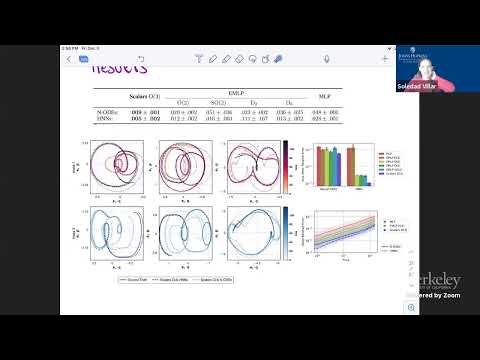
Provides a concrete, dimension-agnostic parameterization: inner products as complete invariants for O(d) and Minkowski variants, and any O(d)-equivariant vector output is a linear combination of inputs — equivariant outputs lie in input span — with scalar coefficients that are invariant functions (polynomial choices give universality). Implements this for rotations, parity, boosts and tests on springed double pendulum, where Hamiltonian-equivariant models beat prior EMLP baselines and give smaller long-term errors; notes n^2 features are avoidable and links to FMM for scaling.
AI-written summary · about
chapters (16)
- 0:00Introduction
- 1:10Motivation
- 2:05Graph Neural Networks
- 3:55Recap
- 4:35Invariant
- 6:00Spectral Methods
- 7:00Community Detection
- 19:40Graph Neural Networks Expressivity
- 23:02Equivariant Machine Learning
- 29:03Output
- 29:40Fundamental Theorem
- 38:36Translation equivalence
- 39:59General groups
- 42:58Numerical examples
- 47:31Conclusion
- 48:26Questions
related talks
 01h 29mBoot camp on invariances in graph learning
 31mInterpretability In Atomic-Scale Machine Learning
 01h 11mHidden Physics Models: Machine Learning of Nonlinear Partial Differential Equations
 57mDarwinian Machine Learning: Principles of Machine Learning in Evo-devo, Evo-eco and Evolutionary...
 53mAdversarial Machine Learning and Instrumental Variables for Flexible Causal Modeling
 56mThe mathematics of machine learning
 01h 04mStatistical Physics and Computation in High Dimension
 01h 07mEfficient Classical Simulation of Many-body Systems with Local Integrals of Motion