Darwinian Machine Learning: Principles of Machine Learning in Evo-devo, Evo-eco and Evolutionary...
summary
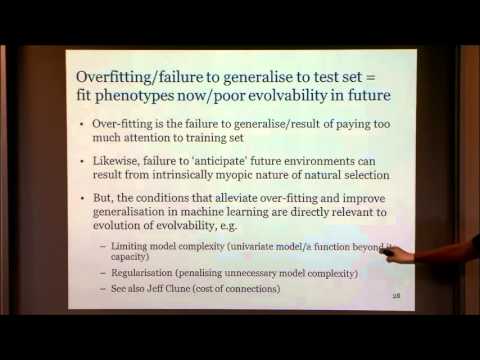
Argues that evolving regulatory matrices (recurrent gene networks) implements Hebbian learning so evolved GRNs become Hopfield-like memories that reconstruct full phenotypes from partial genotypes and generalize to novel module combinations; shows sparse-penalty regularization improves that generalization. Uses N-species Lotka-Volterra community matrix evolution to get ecosystem attractors, hysteresis and catastrophic shifts. Introduces a migrant-pool versus vertical inheritance model where evolving selective “handcuffs” (symbioses) lets groups escape local equilibria and yields an algorithm that solves a hierarchical Ising problem in polynomial time.
AI-written summary · about
chapters (11)
- 0:00Evolutionary processes
- 1:30Defining the Darwin machine
- 5:13Framework for evolution
- 7:52Machine learning parallels
- 10:53Genotype-phenotype evolution
- 19:20Generalization and adaptation
- 27:28Ecological networks
- 33:43Deep evolution analogy
- 36:16Reproductive units
- 43:27Synthesis and conclusion
- 51:53Discussion
related talks
 49mPedro Domingos, Professor, University of Washington
 49mML: Teaching machine to learn from its own mistakes (...)
 01h 07mTheory of Computation II
 31mInterpreting Machine Learning From the Perspective of Nonequilibrium Systems
 41mArtificial Intelligence: Let's Think About Learning
 13mThe dynamical view of machine learning: implicit biases of large learning rates
 30mTowards Trustworthy AI: Reflections on Learning and Smale's Legacy
 42mLet's Talk About Sex: Breeding Programs with Evolution