Hidden Physics Models: Machine Learning of Nonlinear Partial Differential Equations
summary
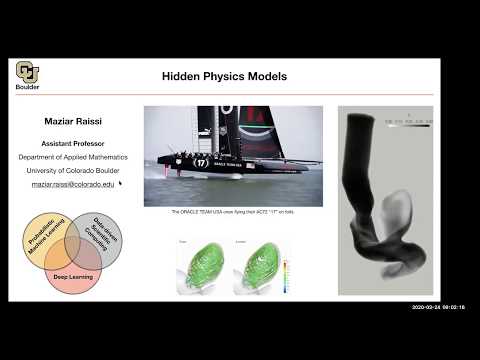
Combines Gaussian-process surrogates and physics-informed priors to learn nonlinear PDEs and parameters from tiny datasets: design optimization of a hydrofoil finds the maximum with about 13 high-fidelity runs plus many 6-minute low-fidelity solves; physics-informed GPs turn PDE coefficients into kernel hyperparameters so two noisy snapshots can identify Burgers or Reynolds numbers; physics-informed neural nets (e.g. 10-layer, 256-neuron tanh network) recover velocity and pressure from passive-scalar data, scale to 100-D Black–Scholes, but fail when the modeled equations omit real experimental forces like gravity.
AI-written summary · about
chapters (13)
- 0:00Introduction by Maziar Raissi
- 1:06Speaker introduction and background
- 13:03Gaussian processes for design optimization
- 19:23Physics-informed Gaussian processes
- 25:07Solving forward and inverse problems
- 31:17Scaling Gaussian processes for big data
- 35:38Neural networks for scientific computing
- 40:22Physics-informed neural networks
- 48:23High-dimensional PDEs with neural networks
- 51:37Learning parameters and new dynamics
- 56:23Pressure field reconstruction in aneurysms
- 1:01:19Applications and future directions
- 1:05:17Q&A session
related talks
 34mData-Driven Solutions in Engineering
 40mBdrygp: A Boundary-Integrated Gaussian Process Model For Computer Code Emulation
 11mDeploying Physics Models at the Edge: Quantized AI for Weather & Fluid Simulation
 31mScientific Machine Learning With NVIDIA PhysicsNeMo
 01h 04mStatistical Physics and Computation in High Dimension
 51mPlaying Newton: Automatic Construction of Phenomenological, Data-Driven Theories and Models
 01h 03mStatistical Physics and Computation in High Dimension
 31mInterpreting Machine Learning From the Perspective of Nonequilibrium Systems