Data-Driven Inverse Modeling with Incomplete Observations

summary
Presents a method that trains neural nets while enforcing PDE constraints exactly by making both explicit and implicit numerical solvers differentiable with reverse‑mode AD, implemented in ADCME.jl (Julia + TensorFlow backend). Claims faster convergence and greater stability than penalty approaches on stiff problems and demonstrates recovery of space‑dependent parameters and constitutive functions, including differentiable implicit PDE solvers that backpropagate through Newton iterations, successful inference of nonlinear relative‑permeability and fractional orders from sparse data, and estimates functions from four sensors with noise robustness.
AI-written summary · about
chapters (9)
- 0:00Introduction to talk
- 1:49Inverse modeling basics
- 3:36Physics-informed neural networks
- 8:36Automatic differentiation overview
- 15:01Applications introduction
- 15:21Elastic full waveform inversion
- 21:01Base car elasticity modeling
- 25:38Summary and future work
- 28:12Q&A session
related talks
 34mData-Driven Solutions in Engineering
 29mPartial Evaluation of Automatic Differentiation for Differential-Algebraic Equati...
 01h 10mThe impact of differentiable programming: how ∂P is enabling new science in Julia
 09mLearning Under Requirements
 39mDifferentiable Functional Programming
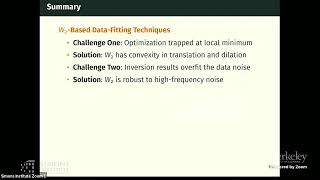 11mOptimal Transport for Inverse Problems
 51mPlaying Newton: Automatic Construction of Phenomenological, Data-Driven Theories and Models
 10mHow DeepInverse Is Solving Imaging in Science and H...