Poseidon: Efficient, Robust, and Practical Datacenter CC via Deployable INT

summary
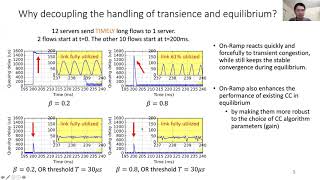
Poseidon uses switch INT to feed a tiny maximum per-hop delay (MPD) tag back to senders and runs an adaptive rate-targeted MIMD update that decouples fairness from AIMD, so each flow computes its own delay target and only reacts to the bottleneck hop. Implemented with two lines of switch code, evaluated in testbed and simulator, Poseidon cuts fabric RTT up to 50%, converges up to 12× faster, reduces throughput variation up to 70% and lowers message transfer time >61% on average, supporting incremental brownfield deployment.
AI-written summary · about
chapters (12)
- 0:00Intro
- 0:27A Good Congestion Control Algorithm
- 1:04React to Every Congestion - Not Max-min Fairness
- 2:44Decrease rate below fair-share - slow convergence
- 3:18Convergence Speed & Stable Rate Trade-off
- 5:09A Practical Low-overhead Quantitative Signal
- 6:32Rate-adaptive Target Enables Different Reactions
- 7:25Adaptive MIMD Rate Update
- 10:16Convergence to Max-min Fairness in a Network
- 11:12Implementation
- 11:37Evaluation Summary
- 12:59Performance Gain for Incremental Deployment
related talks
 17mPOSEIDON: A Consolidated Virtual Network Controller that Manages Millions of Tenants...
 20mPostMan: Rapidly Mitigating Bursty Traffic by Offloading Packet Processing
 18mCCC: Re-architecting Delay-based Congestion Control in Datacenter Networks
 23mMulti-Path Transport for RDMA in Datacenters
 16mPRED: Performance-oriented Random Early Detection for Consistently Stable Performance...
 12mBreaking the Transience-Equilibrium Nexus: A New Approach to Datacenter Packet Transport
 15mCost-effective and Reliable Global Internet Peering with Programmable Switches
 19mCluster Optimization: Harnessing DPUs for Ambient Mesh Workloads