Food and Liquid Sensing in Practical Environments using RFIDs

summary
System senses food and liquids inside closed containers using off‑the‑shelf passive backscatter RFID tags and a reader (USRP/X310 setup) to record amplitude and phase across 450–1,000 MHz; a prototype collects >2,000 samples across seven applications (fake medicine, adulterated baby formula, counterfeit perfume, alcohol, wine, oil, soda). The core is a multipath kernel + VAE that synthetically generates unseen environments, supports anomaly detection and transfer learning, and yields >90% classification accuracy where prior RFID methods fail.
AI-written summary · about
chapters (12)
- 0:00Intro
- 0:28Can we sense food and liquids in closed containers?
- 1:58Approach: Exploit the wireless interaction between an RFID and the content
- 5:43Experiment in a Different Environment
- 7:59Decomposing the RFID Channel
- 8:57Multipath Kernel Allows Generating Environment-only Features
- 13:10Leverage Multipath Kernel to Detect Anomalies
- 14:26Implementation
- 15:09Applications Tested
- 15:33Training & Testing in Different Environments
- 17:14Accuracy vs Dielectric
- 18:06Conclusion
related talks
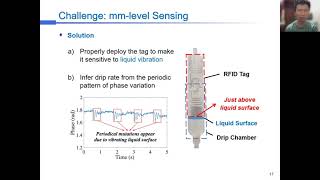 06mDropMonitor: Millimeter-level Sensing for RFID-based Infusion Drip Rate Monitoring
 16mRFID+: Spatially Controllable Identification of UHF RFIDs via Controlled Magnetic Fields
 06mEmbracing Collisions to Increase Fidelity of Sensing Systems with COTS Tags
 17mRF-Chord: Towards Deployable RFID Localization System for Logistic Networks
 18mRetwork: Exploring Reader Network with COTS RFID Systems
 18mWireless Analytics for 3D Printed Objects
 06mFull-Dimension Relative Positioning for RFID-Enabled Self-Checkout Services
 10mContactless Level Sensor in Agriculture: A Wide Range of Applications