Exploiting a Natural Network Effect for Scalable, Fine-grained Clock Synchronization

summary
Software system HUYGENS synchronizes data center clocks to a few 10s of nanoseconds by combining coded probes that filter 90% of queuing-noisy samples, support vector machines to fit one-way delays and estimate offset and drift, and a dense network effect that uses loops to reduce edge errors. Implementation runs on commodity NIC timestamps, probes at ~5 Mb/s with K=10–20 peers, validates against FPGA-ground truth (30 ns after network correction), stays within tens of ns under 90% load, and outperforms NTP by ~4 orders of magnitude.
AI-written summary · about
chapters (16)
- 0:00Intro
- 0:35Background and Motivation
- 1:24Example: distributed databases
- 2:53Syncing clocks with probes
- 3:39Where to take timestamps
- 5:37How to process timestamps
- 7:22Basic idea behind Huygens
- 8:15Clock bounds over time
- 10:09Clock drift distribution
- 10:53Nonlinear clock drifts
- 12:00Syncing clocks with SVMs
- 13:18Coded probes
- 15:18The network effect
- 19:21Deployments
- 19:44NetFPGA verification
- 21:39Conclusion
related talks
 21mTime Synchronization using ML Techniques in Electronic Trading
 46mSelf-Programming Networks: Network Clock Synchronization, Event Playback and Real-time Action
 14mSyncWise: Error-Aware Time Synchronization for Reconfigurable Data Center Networks
 43mDo the Time Warp – the Rocky Horror PTP Show: Verification of Network Time...
 25mRF System Synchronization - Baseband
 16mRock around the Clock (Synchronization): Improve Performance...
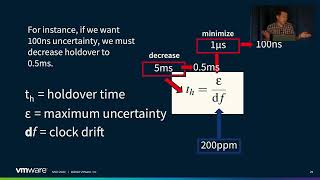 17mGraham: Synchronizing Clocks by Leveraging Local Clock Properties
 43mTic-Tac... Bomb! Master time and NTP before it's too late