RF System Synchronization - Baseband
summary
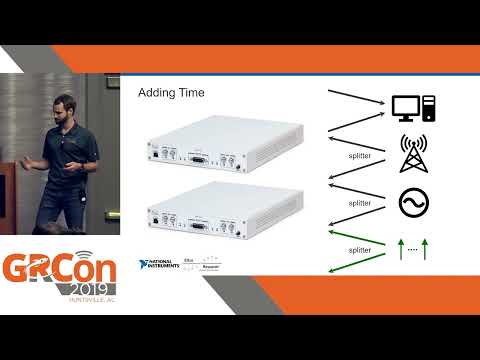
Compares concrete methods for baseband sync on USRP hardware: use a shared 10 MHz reference, distribute PPS for a common timekeeper, and prefer a star/matched‑length topology over daisy chains to avoid converter‑clock and PLL phase ambiguity. Notes FPGA flip‑flop setup/hold metastability and temperature‑driven drift. Reports practical numbers: White Rabbit enables baseband clock and time synchronization of less than 1 ns at distances up to 10 km, and measured ~200 ps typical across 5 km on N310/N320 family.
AI-written summary · about
chapters (9)
- 0:00Start
- 1:45The Rf Subsystem
- 2:08The Reference Clock Input and Fan Out
- 4:32Data in the Time Domain
- 7:03External Reference Clock
- 18:21Geographically Distributed Systems
- 20:08Introduction
- 22:24Summary
- 23:41Does White Rabbit Require Xilinx Ip
related talks
 26mExploiting a Natural Network Effect for Scalable, Fine-grained Clock Synchronization
 28mAdventures in RFNoC: Lessons Learned From Developing a Real-Time Spectrum Sensing Block
 27mGNU Radio in a Direct-RF World
 43mDo the Time Warp – the Rocky Horror PTP Show: Verification of Network Time...
 14mSyncWise: Error-Aware Time Synchronization for Reconfigurable Data Center Networks
 24mMeet the Family: RFNoC Blocks in UHD
 01h 02mHacking the Wireless World with Software Defined Radio - 2.0
 16mModular transmit / receive station control